
In 2026, having a strong online presence is no longer optional for small businesses; rather, it is essential. However, while website design and digital marketing often receive most of the attention, web hosting remains the backbone of any successful online operation. Without reliable hosting, even the most beautifully designed website can suffer from slow loading times, security vulnerabilities, and frequent downtime. Therefore, choosing the best web hosting solutions for small businesses in 2026 is a critical decision that directly impacts performance, SEO, customer experience, and revenue.
Moreover, as competition continues to grow, customers expect fast, secure, and seamless digital experiences. Consequently, small businesses must select hosting solutions that not only meet current needs but also support long-term scalability. In this comprehensive guide, we will explore everything you need to know about selecting the right hosting provider, comparing hosting types, understanding key features, and making a future-proof decision.
The Significance of Web Hosting in 2026
First and foremost, web hosting determines how quickly your website loads. Since search engines prioritize speed, hosting plays a direct role in your rankings. Additionally, customers are less patient than ever. In fact, if a site takes more than a few seconds to load, users are likely to leave immediately. As a result, poor hosting can lead to lost traffic and decreased conversions.
Furthermore, cybersecurity threats are increasing every year. Therefore, hosting providers must offer advanced security measures such as SSL certificates, firewalls, malware protection, and automated backups. Not only does this protect your data, but it also builds trust with customers.
Equally important, reliable hosting ensures minimal downtime. Because downtime means lost sales opportunities, businesses cannot afford unstable servers. Consequently, uptime guarantees of 99.9% or higher are now considered standard.
In addition, scalability has become essential. As businesses grow, traffic increases. Thus, hosting solutions must allow seamless upgrades without requiring complete migration.
Types of Web Hosting for Small Businesses
Before choosing a provider, it is crucial to understand the different hosting types available. Each type offers distinct benefits, and therefore, selecting the right one depends on your business size, budget, and technical requirements.
1. Shared Hosting
Shared hosting is typically the most affordable option. In this setup, multiple websites share the same server resources. As a result, costs are lower. Therefore, shared hosting is ideal for startups and small websites with limited traffic.
However, since resources are shared, performance can fluctuate. Additionally, heavy traffic on another site could impact yours. Nevertheless, for beginners, shared hosting remains a practical starting point.
2. VPS Hosting (Virtual Private Server)
On the other hand, VPS hosting offers more control and dedicated resources within a shared environment. Because it provides better performance and customization, it is suitable for growing businesses.
Moreover, VPS hosting improves security and reliability. Therefore, businesses experiencing steady traffic growth often upgrade to VPS hosting.
3. Dedicated Hosting
Dedicated hosting provides an entire server exclusively for one business. Consequently, it offers maximum performance, control, and security. However, it is more expensive.
Thus, dedicated hosting is typically recommended for high-traffic businesses or companies handling sensitive data.
4. Cloud Hosting
Cloud hosting has become increasingly popular in 2026. Therefore, if one server fails, another takes over instantly.
Because of its scalability and reliability, cloud hosting is ideal for small businesses expecting rapid growth. Additionally, it often operates on a pay-as-you-go model, which improves cost efficiency.
Key Features to Look for in 2026
Since technology evolves rapidly, hosting providers now offer advanced features that were once considered premium. Therefore, small businesses should carefully evaluate the following:
Speed & Performance Optimization
Fast loading speeds are critical. Look for:
-
NVMe SSD storage
-
CDN integration
-
Server-side caching
-
HTTP/3 support
Because faster websites web hosting rank higher and convert better, performance optimization should be a top priority.
Security Measures
Security features should include:
-
Free SSL certificates
-
Daily automated backups
-
DDoS protection
-
Malware scanning
-
Two-factor authentication
Given the increasing cybersecurity risks, robust protection is non-negotiable.
Scalability Options
As your business grows, hosting must scale accordingly. Therefore, choose providers offering seamless upgrades without downtime.
Customer Support
Since technical issues can arise unexpectedly, 24/7 customer support is essential. Moreover, live chat and phone support are preferable for immediate assistance.
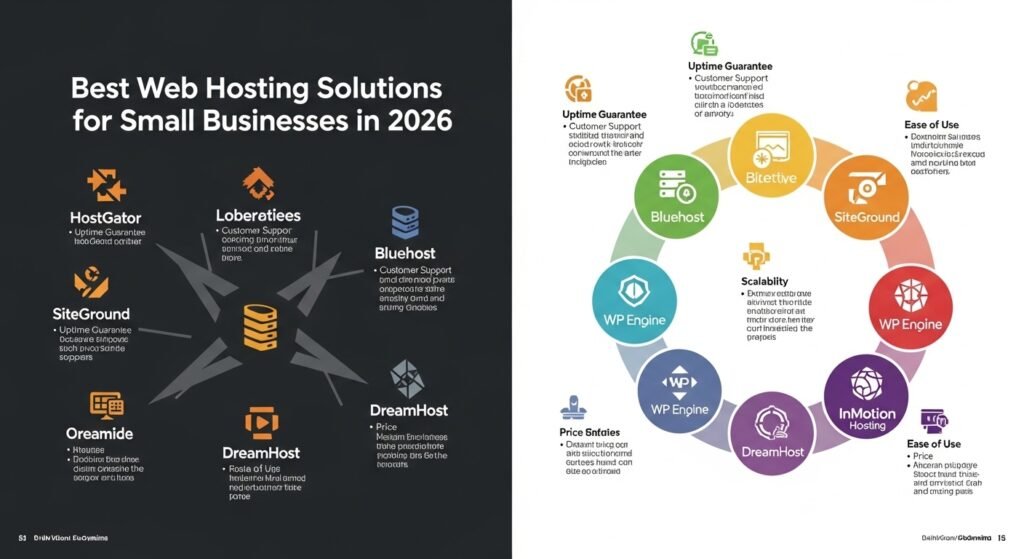
Best Web Hosting Solutions for Small Businesses in 2026
While many hosting providers exist, some stand out due to performance, reliability, and value.
1. Bluehost
Bluehost remains a popular choice for beginners. It offers affordable shared hosting plans, free SSL certificates, and easy WordPress integration. Furthermore, its user-friendly interface makes it ideal for small business owners without technical expertise.
2. SiteGround
SiteGround is known for exceptional speed and customer support. Additionally, it offers strong security features and daily backups. Therefore, it is suitable for businesses that prioritize performance.
3. Hostinger
Hostinger provides budget-friendly hosting without sacrificing speed. Because of its competitive pricing and scalable plans, it appeals to startups.
4. Cloudways
Cloudways specializes in managed cloud hosting. Consequently, it combines flexibility with high performance. For growing businesses, it offers excellent scalability.
5. A2 Hosting
A2 Hosting emphasizes speed optimization. Moreover, its turbo servers enhance loading times significantly.
How Hosting Impacts SEO
Interestingly, hosting directly affects search engine rankings. Since Google prioritizes fast, secure websites, hosting influences:
-
Page speed
-
Uptime
-
Server response time
-
Security protocols
Therefore, investing in quality hosting indirectly boosts SEO performance.
Additionally, reliable hosting improves user experience, which further enhances dwell time and reduces bounce rates.
Cost Considerations for Small Businesses
Budget plays a significant role in decision-making. However, while low-cost hosting may seem attractive initially, it can lead to hidden expenses due to downtime or slow performance.
Thus, instead of focusing solely on price, evaluate:
-
Renewal rates
-
Upgrade costs
-
Included features
-
Long-term scalability
In many cases, slightly higher initial investment results in better long-term value.
Managed vs Unmanaged Hosting
Another important consideration is whether to choose managed or unmanaged hosting.
Managed hosting providers handle:
-
Updates
-
Security patches
-
Backups
-
Maintenance
Therefore, it is ideal for non-technical business owners.
Conversely, unmanaged hosting requires technical expertise but offers greater control. Hence, it suits developers and tech-savvy businesses.
Migration & Ease of Setup
Switching hosting providers can be complex. Therefore, choose providers offering free migration services.
Additionally, one-click installations for CMS platforms like WordPress simplify setup. Because ease of use saves time, it allows business owners to focus on growth rather than technical tasks.
Sustainability & Green Hosting
In 2026, environmental sustainability is becoming increasingly important. Consequently, many hosting companies now operate energy-efficient data centers.
Therefore, small businesses aiming to promote eco-friendly branding may consider green hosting solutions.
Final Thoughts: Choosing the Right Hosting Partner
Ultimately, selecting the best web hosting solutions for small businesses in 2026 requires balancing performance, security, scalability, and cost. While shared hosting may work for startups, cloud hosting and VPS options provide better growth opportunities.
Furthermore, since hosting directly impacts SEO, user experience, and conversions, it should never be an afterthought. Instead, it should be viewed as a strategic investment.
In conclusion, small businesses should carefully assess their current needs, anticipate future growth, and choose a hosting provider that offers reliability, flexibility, Best Web Hosting Solutions and strong customer support. By doing so, they will establish a solid digital foundation capable of supporting long-term success.